

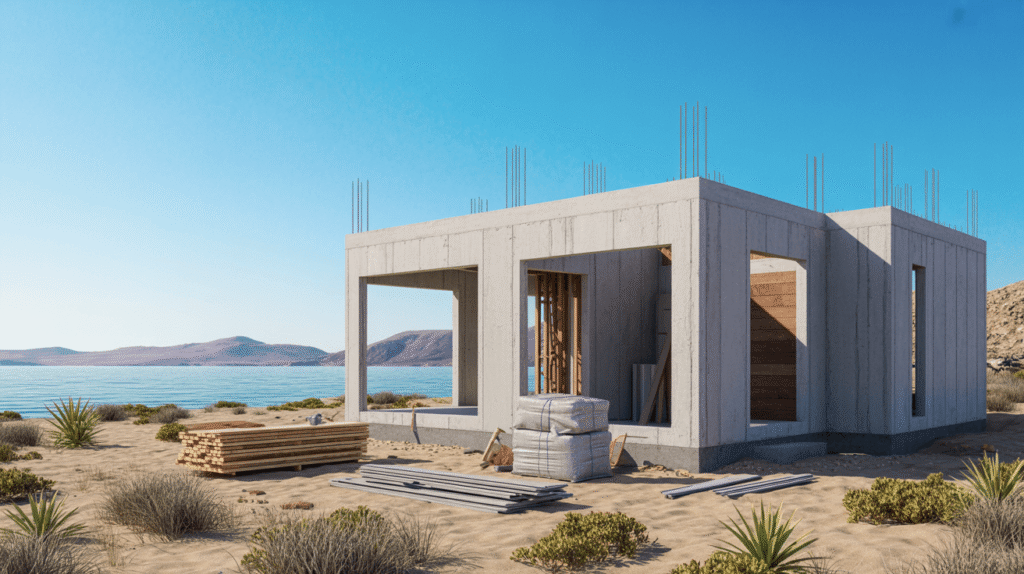
Once you’ve secured your lot, the next big dream kicks in: actually building your beach house in San Felipe.
You can already see it—coffee on the terrace with Sea of Cortez views, a shaded patio for friends, a guest room for the kids or grandkids. But then the questions hit:
- How much does it really cost to build here?
- What permits do I need—and who handles them?
- How long does the process actually take in Baja?
This guide walks you through what it looks like to build a beach house in San Felipe, step by step—from first sketch to move-in—so you can plan with realistic expectations instead of guesses.
1. Start With the Big Picture: What Kind of House Do You Want?
Before you talk about pesos, permits, or timelines, you need clarity on your vision:
- Will this be a full-time home, winter home, or vacation property?
- Do you want one story or two? (Many retirees prefer single-story for accessibility.)
- Are you thinking modest and efficient, or more of a statement home with big glass and high-end finishes?
- How many bedrooms/bathrooms do you actually need?
Your answers will directly affect:
- Square footage
- Structural design (especially for wind, sun, and potential seismic considerations)
- Total budget and timeline
A good local architect or builder will start by asking lifestyle questions before talking about concrete and rebar.
2. Timeline Overview: From Idea to Move-In
Every project is different, but a realistic timeline for building a beach house in San Felipe often looks like this:
- Concept & Design: 1–3 months
- Define needs, budget, and style.
- Work with architect to create floorplan, elevations, and basic specifications.
- Permits & Approvals: 1–3+ months
- Municipality permits, environmental considerations (depending on location), and any HOA/architectural committee approvals.
- Construction Phase: 6–12+ months
- Rough-in (foundation, structure, roof).
- Systems (plumbing, electrical, septic, cisterns).
- Finishes (windows, doors, floors, kitchen, bathrooms, paint).
- Finishing Touches & Handover: 1–2 months
- Punch list, corrections, final inspections.
- Utility connections finalization, furnishing, and move-in.
In a best-case scenario with a simple, well-managed build, some smaller homes may come together in under a year. Larger, more complex homes or projects with infrastructure challenges can run longer. Weather, supply availability, and bureaucracy all add friction—this is Mexico, not a U.S. production-home subdivision.
3. Designing for San Felipe’s Climate & Terrain
San Felipe means desert + sea. That brings specific design priorities:
Sun, heat and orientation
- Orient the house to maximize views but reduce harsh afternoon sun hitting large glass surfaces.
- Use covered patios, pergolas and deep overhangs to create shade and protect windows and doors.
- Plan cross-ventilation: windows and openings positioned so breezes can move through the house.
Materials and finishes
- Concrete block and reinforced concrete are common for structure.
- Use salt-tolerant finishes and corrosion-resistant hardware near the sea.
- Floor choices like tile or polished concrete handle sand and temperature changes better than some wood products.
Outdoor living
In San Felipe, your “living room” often extends outside:
- Shaded patios
- Outdoor kitchens or BBQ areas
- Storage for beach gear, kayaks, ATVs, etc.
A smart design will treat outdoor space as a core part of the home, not an afterthought.
4. Permits & Approvals: Who Does What?
You don’t need to personally navigate every government office—but you do need a team that understands the process.
Municipality building permit
Your architect or contractor typically handles:
- Submitting architectural plans to the local municipality for approval.
- Ensuring the design complies with zoning, setbacks, height limits, and land-use regulations.
- Obtaining the official construction license/permit.
Your job is to make sure:
- The lot is properly titled and in your fideicomiso or legal structure.
- Any community or HOA rules (height, color, style, setbacks) are respected and approved.
HOA / architectural committee (if applicable)
If your lot is in a gated or master-planned community:
- There may be an architectural review committee.
- They’ll look at your plans to enforce design guidelines, color palettes, height restrictions, and view corridors.
A good architect who has already worked in that development is gold here—they’ll know what flies and what doesn’t.
5. Real Costs: What Does It Take to Build?
There’s no single answer, because costs vary by:
- Size of the house
- Quality of finishes
- Complexity of design
- Infrastructure already present (or not) in your development
But you can think in terms of three main buckets:
1. Core construction cost
This covers structure, walls, roof, flooring, basic finishes, plumbing, and electrical.
- Smaller, modest homes with simple designs and mid-range finishes will sit on the lower end.
- Larger homes, custom designs, high-end imported finishes, big glass doors/windows, and complex roofs will cost more.
2. Site work & infrastructure
Depending on your lot, you may need:
- Septic system or connection to community system
- Water connection, cisterns, pumps, filtration
- Electrical connection, solar system (if desired), backup generator
- Driveway, retaining walls, grading, and drainage solutions
Lots that already have utilities stubbed in and roads built will save you time and money compared to raw, un-serviced land.
3. Soft costs & extras
- Architect and engineering fees
- Permit fees
- Legal or notary services related to construction contracts (optional but wise for larger builds)
- Furniture, appliances, and landscaping
One practical strategy many buyers in Baja use is to:
- Define a total budget (for example: “I’m comfortable spending X total, including furnishings”).
- Work backwards with the architect and builder to determine a realistic house size and finish level within that envelope.
Trying to design your dream 3,500 sq ft house and then forcing it into a tight budget is the fastest way to disappointment or unfinished projects.
6. Choosing a Builder and Contract Type
Your builder will make or break your experience.
What to look for in a contractor
- Local references—visit actual homes they’ve built, ideally talk to clients.
- Clear written estimates and work scopes.
- Experience working with foreign clients and bank-trust properties.
- Openness to staged payments based on milestones, not just time.
Lump sum vs. staged builds
Some people choose a “turnkey” contract: one main builder responsible for the whole project. Others break it into stages:
- Stage 1: Foundation + structure + roof
- Stage 2: Systems (plumbing, electrical, septic, cisterns)
- Stage 3: Finishes and details
Staging can help if you want to build over a longer period, but it requires more coordination and discipline.
Whichever route you choose:
- Always sign a written contract, in Spanish (the legal version) and with an English summary you understand.
- Tie payments to progress, not just dates (e.g., X% when roof is completed and inspected).
- Keep copies of receipts, plans, and communications.
7. Common Pitfalls (And How to Avoid Them)
Even experienced buyers can run into issues. Some frequent mistakes when building a beach house in San Felipe:
1. Designing like it’s San Diego
Bringing a U.S. coastal design directly to a desert + salt + sun environment can result in:
- Overheating interiors
- High cooling costs
- Rapid wear on some materials
Solution: Work with local architects and builders who understand orientation, shade, and materials that hold up in this climate.
2. Underestimating infrastructure
It’s easy to focus on the house and overlook:
- Septic design
- Water storage and pressure systems
- Drainage (where does water go when it rains hard on desert soil?)
Solution: Make infrastructure a specific line item in the design and budget from day one.
3. Paying too much too fast
Sending large upfront payments before work is done or contracts are in place is risky anywhere—especially across borders.
Solution:
- Use milestone-based payments.
- Insist on written receipts and documentation.
- Consider having an independent project manager or architect oversee progress and sign off before each payment.
4. Building bigger than your lifestyle (or budget)
It’s tempting to add more bedrooms, more terraces, more everything. But larger homes:
- Cost more to build, cool, clean, and maintain.
- Can become a burden rather than a blessing.
Solution: Design around how you truly live: your daily routines, how often guests visit, and how much space you realistically use.
8. A Smart Path: Buy the Lot Now, Build in Phases
Many Americans in San Felipe choose a phased strategy:
- Secure the lot in a well-located, legally solid community.
- Spend time getting to know the area, local professionals, and your true needs.
- Work on design while you’re still living part-time elsewhere.
- Begin building when your budget and timing are right.
Phase-building reduces pressure and allows you to make better decisions with local knowledge instead of from a distance.
Is Building a Beach House in San Felipe Right for You?
If you like the idea of:
- A custom home designed around your lifestyle
- Sea and desert views without California-level costs
- A project you can manage in clear stages
…then building in San Felipe can be an incredibly satisfying path.
The keys to success are simple, but non-negotiable:
- Plan carefully with realistic budgets.
- Work with trusted, local professionals.
- Respect permits, timelines, and the climate.
Do that, and each step—foundation, walls, roof, finishes—brings you closer to something very few people ever have: a beach house you designed, in a place where your time moves slower and your money goes further.